A thin non-conducting ring of radius R has a linear charge density λ = λ 0 cos φ φ , where λ 0 is a constant, φ φ is the azimuthal angle. Find the magnitude of the electric field strength
Text Solution
Verified by ExpertsCHECK THE SOLUTION.

E =  .
.
For x >> R this strength  ,
,
where p = πR 2λ 0 .
Sol. Lets take a small element at an angle φ φ subtending angle d φ φ at the center. Charge on this element will be dq = λ (Rd φ φ ) = λ 0 cos φ φ (Rd φ φ )
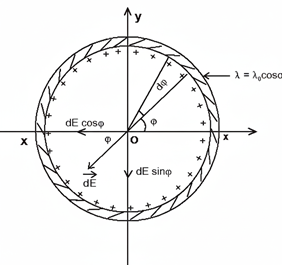
Due to this element, electric field at center will be
dE = 
The y component dE sin φ φ will be cancelled by the opposite element of lower half and the x component dE cos φ φ will be added up
So E net = 
E net =  =
= 
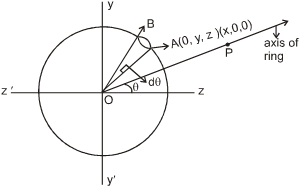
Let the ring plane coincides with y-z plane shown in fig. We consider a small element AB (of length dl) on ring.
Here dl = Rdθ where R is the radius of ring.
Also, from fig. y = R sin θ and z = R cos θ
The electric charge on the considered element is dq = λdl
= λ 0 cosθ (Rdθ) = λ 0 R cos θdθ
The axis of the ring is X-axis.
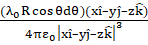
The electric field at point P due to considered element is
 =
=  or
or  =
= 
or  =
= 
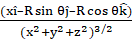
= 
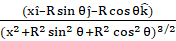
= 
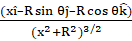
∴ 
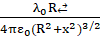 (x cos θd θ
  – Rsinθ cosθ
  – R cos 2 θd θ
  )
)
∴ dE x = 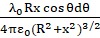
dE y = 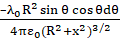
and dE 2 = 
∴ E x = 
After integrating, E x = 0 and
E y = 
= 
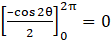
E y = 0
similarly,
E z =  =
= 
∴  = E x
= E x  + E y
+ E y  + E z
+ E z 
∴ 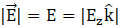 ( E x = 0, E y = 0)
= 
For x > > R, R 2 + x 2 = x 2 ∴ E =  =
= 
Where P = λ 0 πR
2
Prepare Smarter with CGP Edu
Get practice questions, solutions, and test series in one place.
Write a Review
Share your experience with this question and solution.
Commentary
Send your comment, doubt, correction, or feedback to admin.
Similar Questions
Explore conceptually related problems